 STOCK PORTFOLIO (ONE)
High Dividend Yields May Not Be The Best Strategy
Learn > Investing > High Yield > Article
At first glance, a high-yield dividend fund can be very appealing. Imagine having $700,000 to invest. If you put that money into a fund with an 11.5% distribution rate, you would see $80,500 in your first year alone. However, if you spread the same $700,000 across a portfolio of high-quality dividend growers yielding about 3.3%, you would only have $23,100 in that first year. It should seem axiomatic that while a larger payment is more tempting, the long-term numbers can be more risky. And, it doesn't take much — if payouts stagnate, principal increases, or inflation reduces your purchasing power, your "high-yield" strategy might end up providing less than a growth-focused approach.
To understand the trade-offs, it's important to examine the connection between your income goal and the capital you need to achieve it.
The formula is simple: Target Income ÷ Yield = Required Capital.
If a retiree wants an annual income of $80,500, the capital needed varies widely based on the yield chosen:
- At a 3.3% yield, about $2.44 million is necessary.
- At a 6% yield, around $1.34 million is required.
- At an 11.5% yield, only $700,000 is needed.
Each of these yields represents a basic trade-off between how much money you need to start with and the potential for future growth and stability.
Let's look at this a little more carefully with the goal of understanding both compounding and dividend growth.
A yield of 8% to 14% is more aggressive and usually carries higher-risk. These holdings might include mortgage REITs (mREITs), business development companies (BDCs), and leveraged covered call funds. While an 11.5% yield helps you reach the $80,500 target with just $700,000, the risks are significant. Many products in this category pay out more cash than they actually earn, which can lead to major principal loss and sudden dividend cuts. Investors may unintentionally be selling off their assets while thinking they are receiving real income. Making a purchase decision with these types of assets would mean carefully looking at their payouts track record and understanding where the company might be vulnerable.
This is not intended to be an advertisement, but it is worth plugging Stock Portfolio (ONE) app here. The scoring system of most stock rankers will primarily rank based on P&L (profit and loss). So, let's look at BDCs for example. When you compare apples to apples, you will see quickly that many BDCs will have a low score. If we take a look at Main Street Capital Corp (NYSE: MAIN ) -- you can see that we've scored this as "B" (Safe). SP1 also helps you decide when to invest in covered calls to give you the best chance at finding the best payouts with a strike that is out of the money when the contract expires (so you keep your investments). Their Interest coverage of (1.1xEBIT/interest) is extremely low - due to legal obligations for paying shareholders. But when you look closer at their Leverage, Liquidity, and a Dividend Track Record of 11.7% over 5 years, you can see this is a solid, growing dividend.
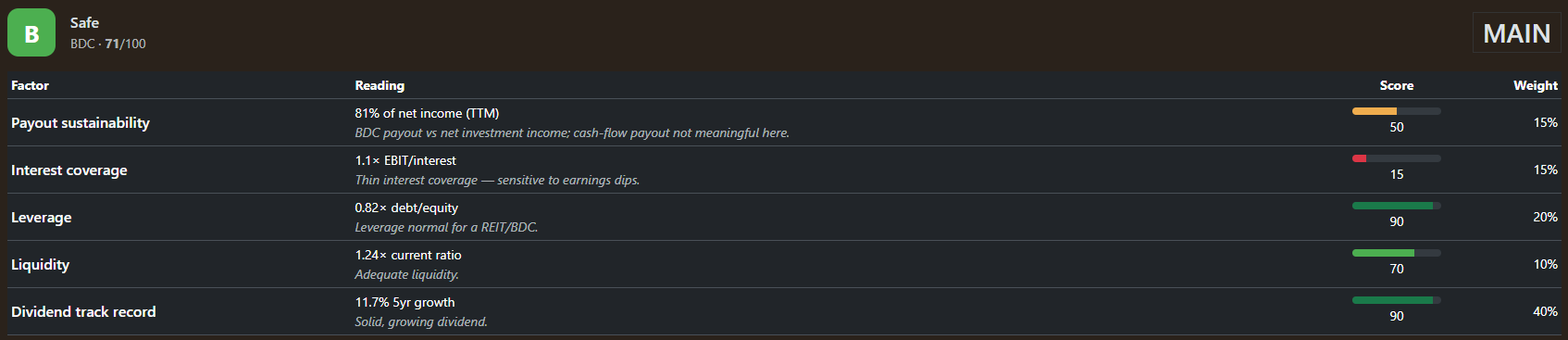
As you can see, there are definitely some investments that are worth looking at even at more aggressive yields.
The middle ground would include assets like equity REITs, covered call ETFs and preferred shares. This, more moderate tier typically has a yield between 5% to 7%. A common example of an asset in this category might be Realty Income (NYSE: O). They have paid out dividends with raises for more than 25 years and, at the time of this writing their yield is a 5.1% — not bad.
If you looking forward to that $80,500 per year, then at a 6% blended yield, your capital requirement is roughly $1.34 million, less than half compared to the next (more conservative tier; we'll look at this next). You should be aware that this tier carries structural risks: covered call strategies may limit your upside, preferred shares can behave like unstable long-term bonds, and REIT payouts depend heavily on real estate cycles and leverage. You receive more cash today but give up the potential for portfolio growth.
That leaves us with the conservative tier (typically between 3% and 4%). Here, we focus on "dividend growers" — companies that consistently increase their dividends. Most of the well-known "Dividend Kings" fall into this category; one in which they have consistently paid and raised their dividends over several decades.
This tier has highest level of capital required to meet our $80,500 per year goal. But, it also carries significant perks:
- Better chance for principal appreciation
- Rising annual income
- Increased simplicity of a "set-and-forget" strategy that avoids the complexities of high-yield options
The impact of "Yield on Cost": It is why we do it!
As a dividend investor, you are probably already aware of the secret power of compounding and dividend growth. It's actually not so secret. But most long-term dividend investors often overlook the "yield on cost" impact. A 3.3% yield growing at an annual rate of 8% will double its payout in roughly nine years. It may take 16 years to catch up to the initial payment of a flat 11.5% yield, but it only takes about 29 years for its total income to exceed it — over time, dividend growth turns modest starting yields into strong income sources.
For example, an investor who bought Broadcom (NASDAQ:AVGO) at a 1.3% yield in 2016 would see their yield on cost grow to about 16.6% today after 14 years of annual increases. This illustrates the "quiet" compounding power that steady growers like PepsiCo and Realty Income provide. Additionally, dividend growers offer both rising payouts and potential capital growth, while high-yield products often lack principal appreciation.
What about Purchasing Power?
Inflation quietly erodes fixed income. With headline PCE inflation recently around 4.1%, a steady 11.5% payout loses significant purchasing power each year. A portfolio that does not grow effectively shrinks in very real terms. On the flip side, a 3.3% yield growing at 8% each year acts as a natural hedge, preserving and even expanding your real wealth against rising costs.
Resilient Dividend Investing Portfolio
To create a portfolio that lasts through the decades, consider these three pillars:
1. Prioritize Spending Need: If you are planning to retire in the next few years, consider spending needs over Salary Replacement. For most people, their expenses drop once they leave the workforce. A lower spending goal reduces the capital needed across all yield tiers.
2. Evaluate Total Return, Not Just Yield: When you compare funds, assess the 10-year total returns using identical dates and reinvestment assumptions. This will show if having a high starting yield was worth the loss in principal growth.
3. Implement a Blended Approach: Most millionaire financial advisors recommend that instead of picking one extreme, combine the tiers:
- Use a core of dividend growers for long-term growth
- Use a portion of moderate-yield REITs for steady cash flow
- Use a small allocation to aggressive products only if you can manage principal fluctuations.
Compare this to the 10-year Treasury yield (around 4.5% recently) — this can help you decide whether the extra risk of equities is worthwhile for higher yields.
A successful portfolio should do more than just pass the "first check" test
While an 11.5% yield can solve immediate cash flow needs with minimal capital, it usually increases vulnerability to inflation, taxes, and cuts in payouts. The most enduring portfolios rely on income growth and durability, focusing on a mix of current cash flow and long-term sustainability rather than the short-term appeal of a high starting yield.